Ten-odd Days
traipsing to see the world, our way
Of Cotton Castle and Fairy Chimneys

After the visit to Ephesus, we were whisked off to a leather apparel factory, which unfortunately took up too much of our time that we arrived at Pamukkale, our next destination, much later than planned.
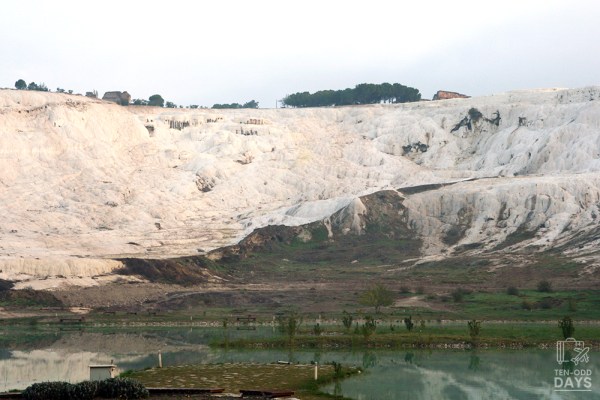
Pamukkale, meaning ‘cotton castle’ in Turkish, is a town in southwestern Turkey most well-known for its mineral rich thermal waters that slowly trickle down cotton-white travertine terraces. The most pervasive image of Pamukkale most people would have has to be white terraces with numerous mini craters filled with sky blue water. This was unfortunately nothing close to what we saw when we arrived close to sundown.


The white travertine terraces were, to our dismay, not white at all. Not even remotely close to white, to be honest. It looked like too many visitors to this site have trampled on and dirtied the once pristine white formations.
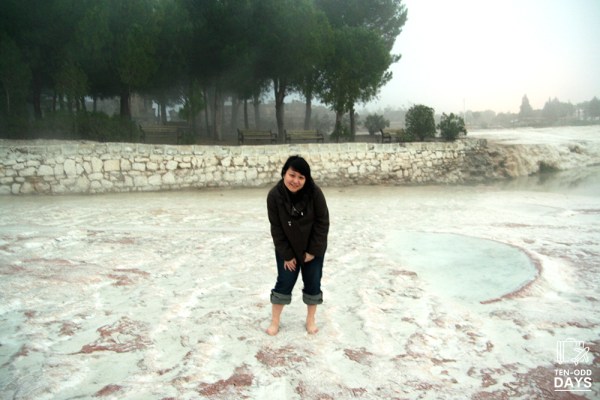
The picture above was heavily edited. Don’t be fooled by how bright it looked; it was almost pitch dark by then. Encouraged by our tour guide, we gingerly took off our shoes and walked around in the thermal waters to have a feel of it. Given how dark it was, we didn’t venture far from the designated pathway.
Since we didn’t get to see much of the site, we were promised that we would be brought back here again next morning for a quick look before continuing on to our next destination. Reluctantly but cautiously, we made our way back to the coach that brought us to our accommodation for the night.
And that was when trouble ensued. I started having the runs the entire night, together with stomach cramps. It wouldn’t be exaggerated to say that I’ve gone to the bathroom close to 20 times before we realised that something was very wrong. The mister sought help from our tour leader, who in turn got in touch with a local doctor to come look in on me. I went to the bathroom another ten times before he arrived, and gave me an injection to alleviate the symptoms. That injection cost us 100USD. 😮 At least it worked; the bathroom visits reduced sharply after the doctor left.
From there on, the trip went downhill for the both of us. For the next couple of days, I almost never got off the coach for sightseeing, sleeping my way through while nursing the bout of stomachache (which very much later my local GP told me it was for certain a bout of food poisoning) unless it wasn’t possible for me to stay in the coach. Many a times I had to coax the mister to go sightsee without me. He would hastily go down, take some pictures, and rush back to the coach to accompany me without lingering. I felt bad and wanted to get well quickly, but it took several days for my stomach to settle again.


I think the group was rather disappointed that we only got to stop at the foot to take pictures of the terraced travertine instead of entering the attraction again. But there was a schedule to keep to, and it was the best our tour leader could bargain for. Kinda wished we didn’t have to go to the leather apparel factory.
After lunch, we headed for Göreme, a town in the Cappadocia region known for the strange naturally-formed rock formations called ‘fairy chimneys’ and hot air balloon rides over the region.
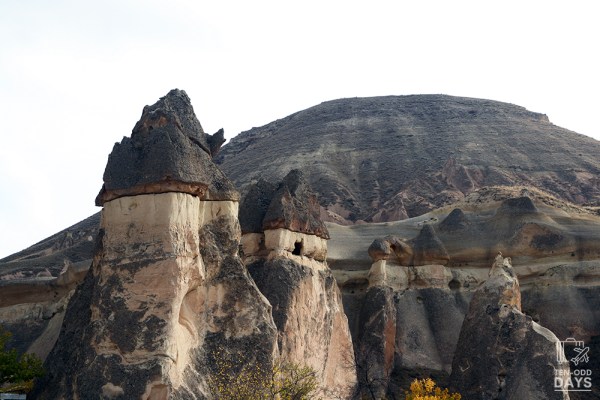
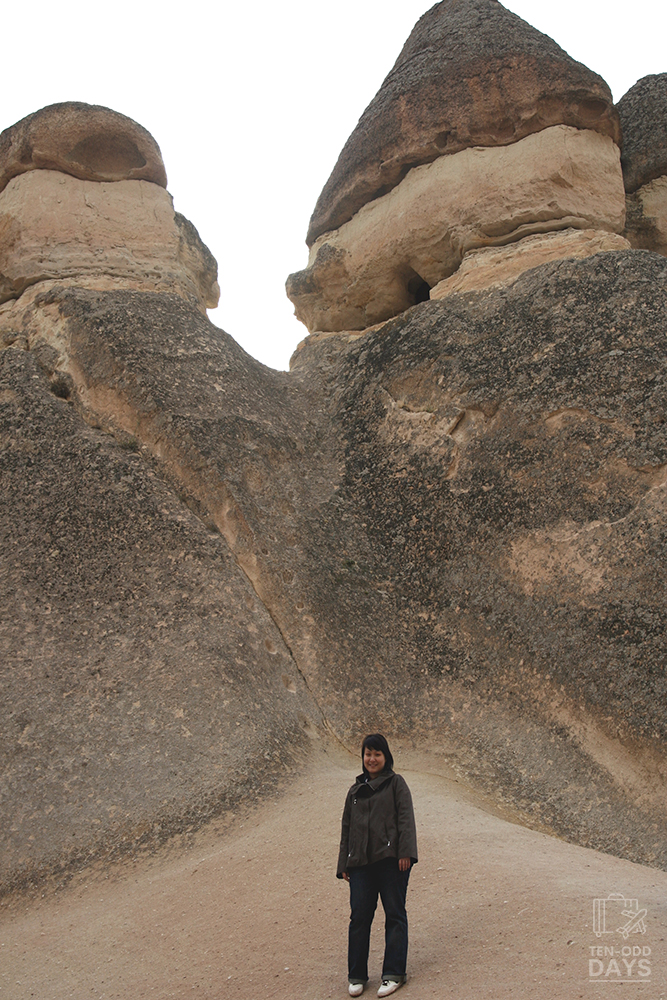
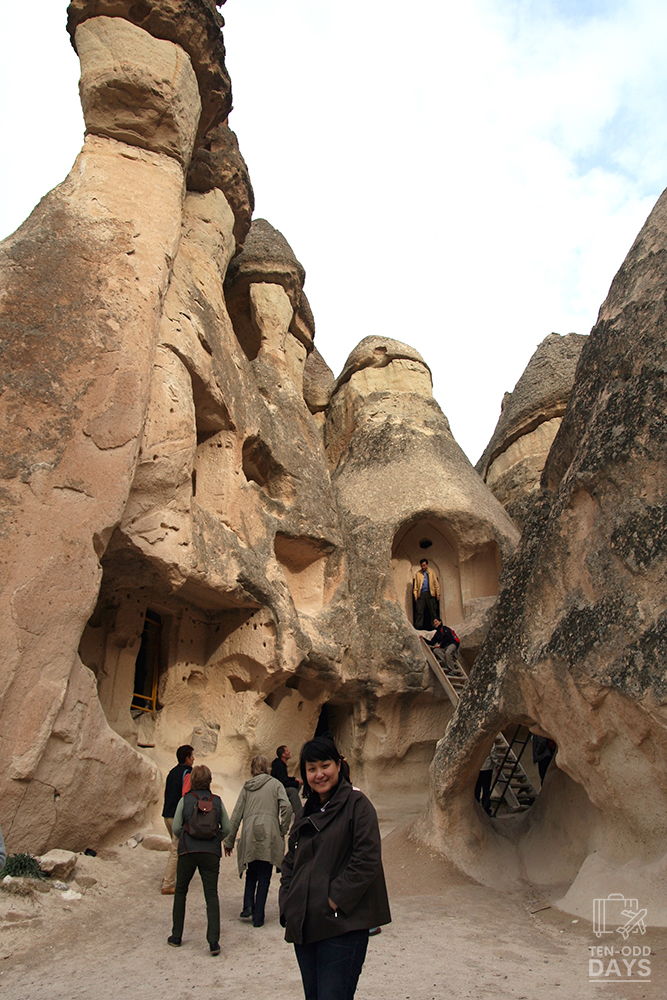
At first glance, the striking fairy chimneys looked really strange to us. Being the good student that I once was, I listened intently as our tour guide started explaining how the geologic processes that commenced millions of years ago first created this unique landscape. Then volcanic eruptions brought ash to this region, which settled and hardened into tuff. Tuff is relatively soft and porous, resulting in rather ingenious ways of using the interesting terrain, chief among which, homes. But this wouldn’t have been possible with simply tuff alone. Along with tuff, basaltic igneous rocks resulted from the violent volcanic eruptions also cooled and settled. Since tuff and basalt erode at different rates, million years of weathering resulted in the mushroom-headed tall columns that we see today. And it’s all natural, not unlike what we see in Meteora, Greece or Zhangjiajie, China.

Cappadocia sat along the historic Silk Road trading route. Prior to that, it was also centrally located, bringing to its region centuries of conflict between warring empires. For that very reason, the town was raided, plundered and invaded several times over the course of time. Natives had retreated into the area, and chiselled into the rock to escape political turmoil. Later, it also became an area of refuge for fleeing Christians escaping from persecution of the Romans, then the Muslims.


The niches chiselled into the fairy chimneys are such amazing work of art! They may not look much from outside, but these columns formed a network of living quarters, churches, stables, stores etc. like a small town would have. And if you look closely at the columns that have been preserved in this open-air museum, one can clearly see how the each room of each dwelling was being utilised.
Of course, these houses were not sufficient to help the refugee Christians escape from their persecutors. Oftentimes, they also had to retreat into their subterranean hideout cities when they heard/saw hostile forces approaching. We visited one of several in the region – Kaymakli Underground Town.
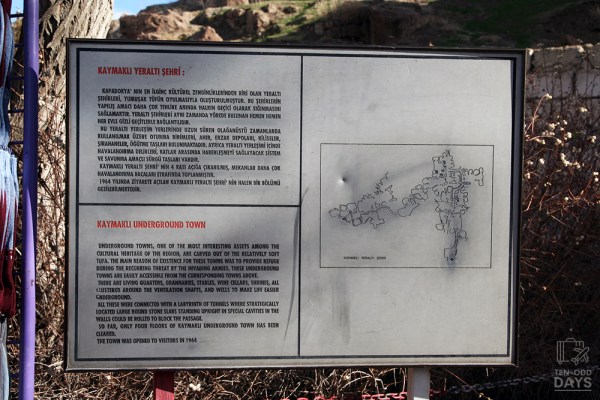
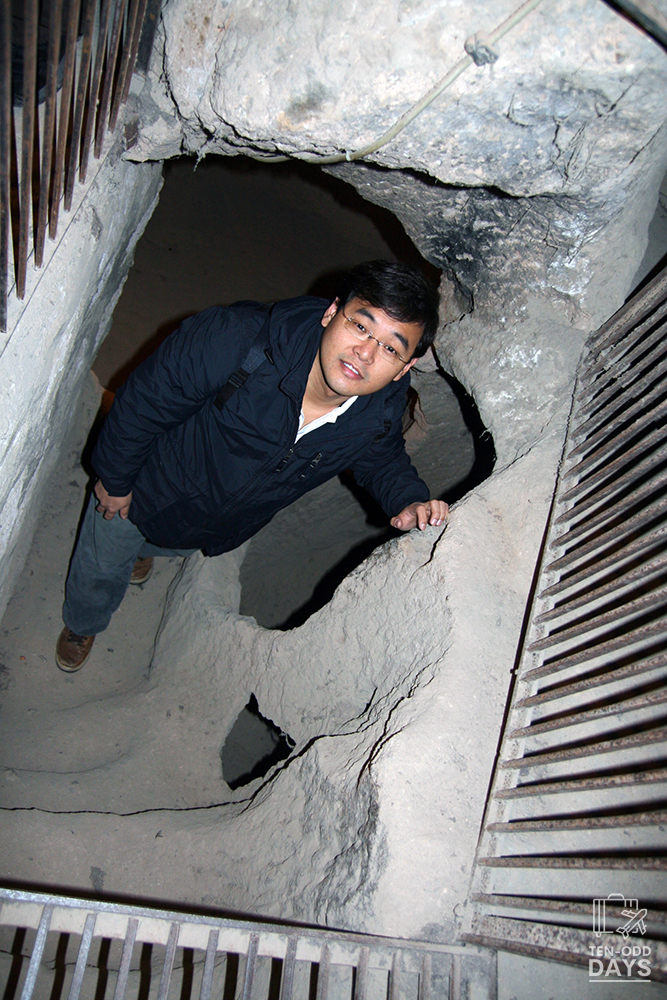
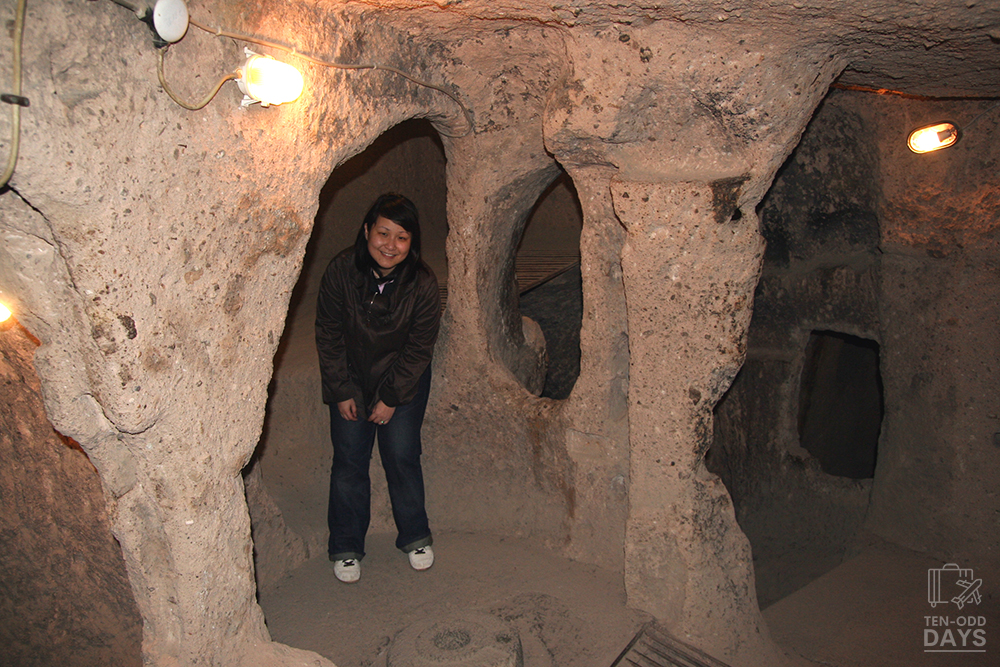
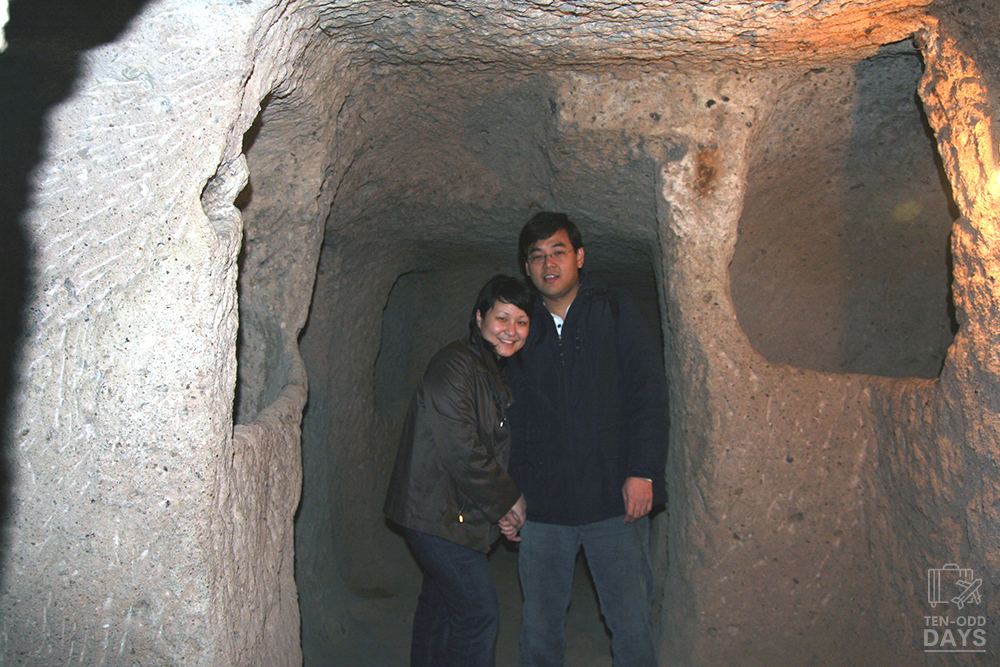
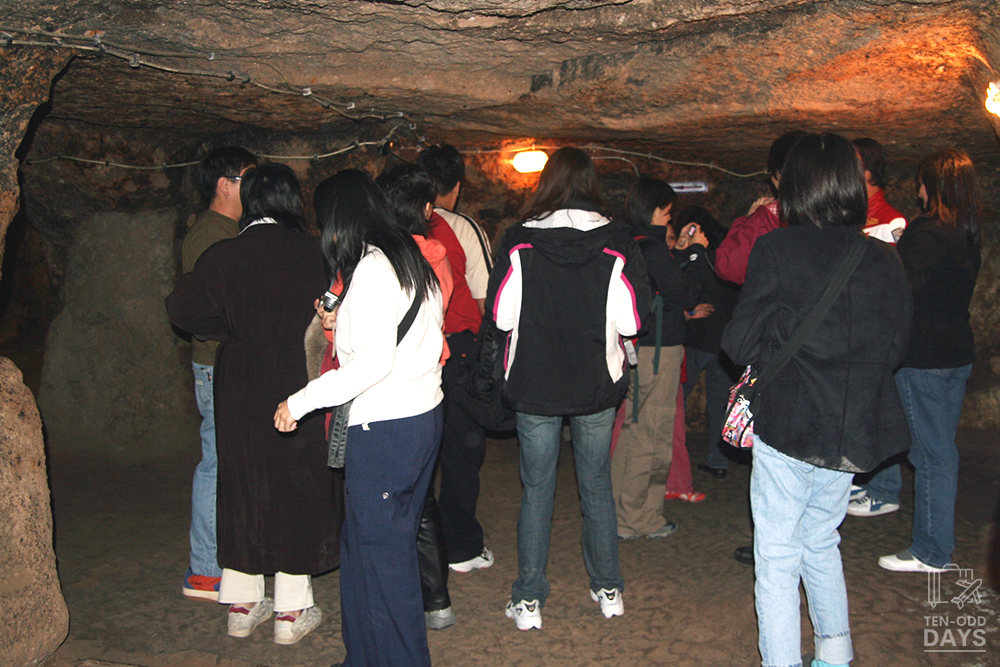
If Kaymakli was anything to go by, these underground towns were really not built for the clastrophobic or the giants that walk amongst us. Some areas were so small we could barely get through. It also reflected something that is universally true – grit and resilience in human beings should never be underestimated. In spite of the extremely harsh living conditions, life went on for the refugees. And in the face of adversity, they even built such remarkable underground towns! Nothing but admiration for them.
The last site we visited in Cappadocia before we left was to the Pigeon Valley. As the name suggests, it’s a valley where a vast number of man-made pigeon holes have been carved into the tuff. We have learnt throughout history, seldom did our ancestors do things out of boredom: the pigeons that lived in the valley in the past used to be trained as message carriers. In modern times though, this practice has gradually become archaic. Very few pigeons now still live in the valley although this stretch has become a rather popular hiking trail.
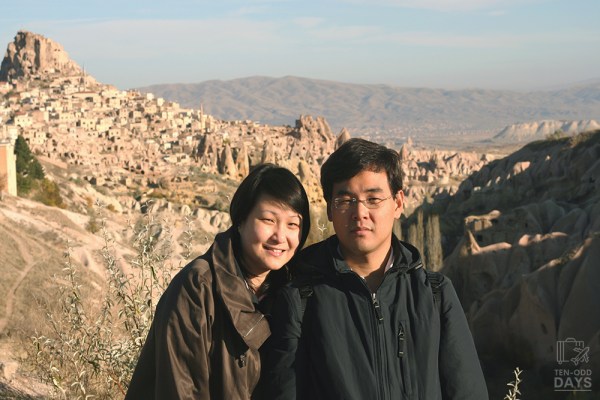
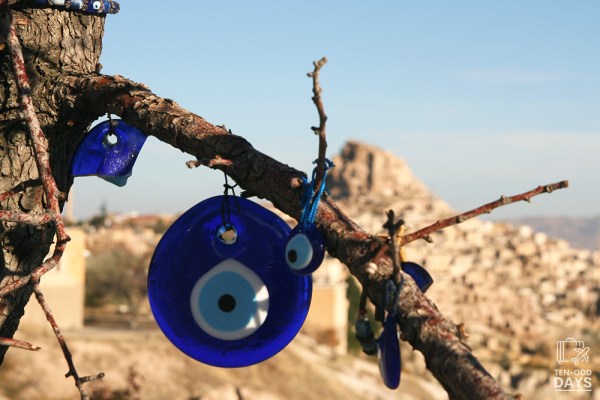
Throughout our tour of Turkey, we kept coming across this blue eye emblem. They come in the form of glass pendants, earrings etc. It is called the Nazar Boncuk, the evil blue eye. It’s supposedly an ancient talisman in the Middle East, that protects the owner/wearer from the bad energies caused by jealousy or envy toward the person. I truly wanted to purchase a small souvenir with the blue eye, but the mister insisted he wanted nothing of that sort anywhere in the house at all. He’s cautious (and perhaps superstitious) like that. And so, we left Turkey with none.
Whatever rocks his boat, I reckon.

One half of Ten-odd Days - the planning, writing and photo-taking half.
 Ten-odd Days